McKinsey Sea Wolf simulator
New microbes, new desired and undesired traits and new target ranges each time. Free play uses one fixed set of sites.
Ready to start?
Three sites, four steps each, and a confirmed step can't be reopened. Pick exactly three microbes per site. One 30-minute clock covers all three sites, and your score is the average efficiency across them.
New here? Read how the game and the scoring work first.
What Sea Wolf is, and what this simulator does
Sea Wolf is the optimisation game in the McKinsey Solve. Some candidates know it as the Ocean Cleanup or Ocean Treatment game. You're on a ship, three stretches of ocean are contaminated, and for each one you have to pick three microbes whose combined profile cleans it up. Candidates report about 30 minutes for all three sites, with an untimed pause between them.
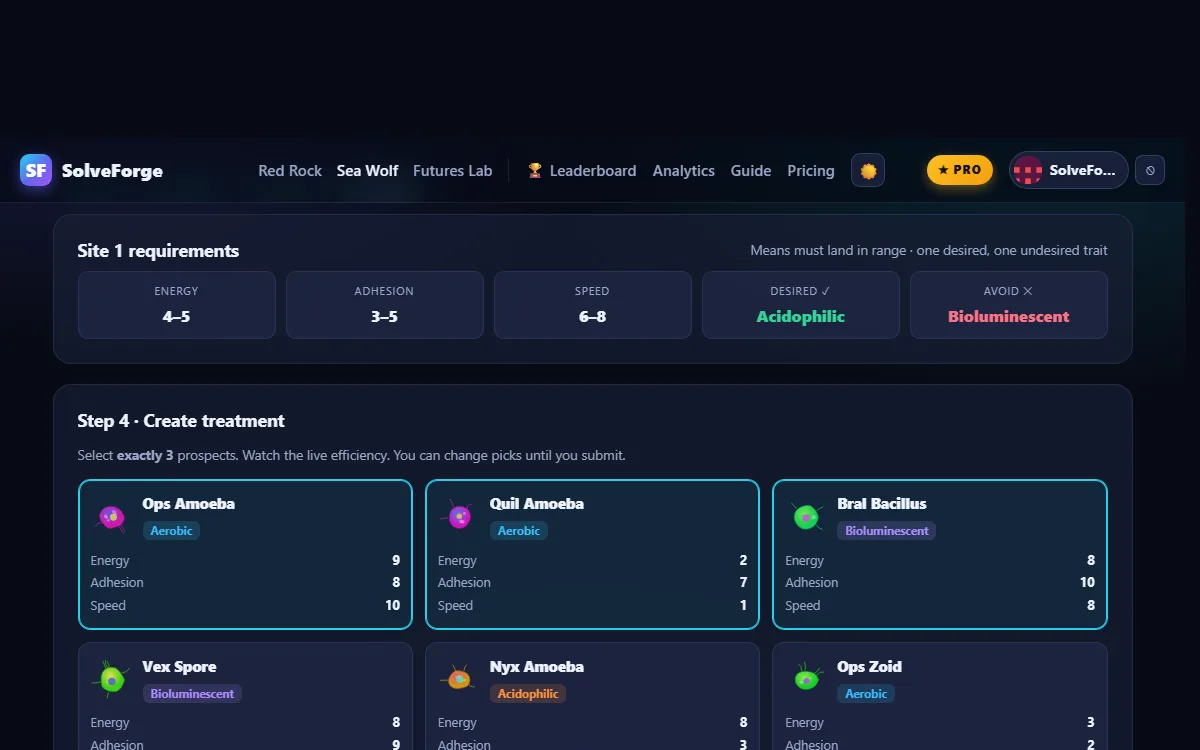
Every microbe has three numeric attributes and a few yes-or-no traits. Every site sets a target range for each attribute, one trait it wants and one it can't tolerate. The catch, and the thing most people get wrong the first time, is that the site is scored on the average of the three microbes you pick, not on each microbe alone. Three individually good microbes can average outside the range.
What this simulator recreates
Three sites on one 30-minute clock, each worked through the same one-way steps: build a profile (choose the two characteristics that matter most), categorize ten microbes (use here, save for later, or reject), build a prospect pool (six given, four more chosen one-of-three across four rounds), then create the treatment by picking exactly three. On sites two and three a short step first shows you the microbes you saved earlier. Once you confirm a step it locks.
Scoring in the simulator: each site starts at 100% efficiency and loses 20% for every attribute whose mean lands outside the target range, 20% if none of your three carries the desired trait, and 20% for each microbe carrying the undesired trait. Your run score is the average across the three sites. After the run you see every site with the trio you picked next to the best trio available from your pool, and you can ask for an emailed breakdown of which penalties cost you the points.
What it doesn't do
It isn't the real test and doesn't use McKinsey's microbes or sites. The mechanics come from public descriptions and candidate reports, and the exact scoring weights McKinsey uses are not published, so the penalty model here is ours. The real assessment is also widely reported to score how you work through the interface, which no practice tool can reproduce.
What's free
One fixed Sea Wolf scenario is free with a free account. Replaying it gives you the same microbes back, which is useful for learning the steps and useless for testing yourself. Pro ($29 for 30 days, one payment, no subscription) builds three new sites every run, with new microbes, new desired and undesired traits and new target ranges, and opens the Sustainable Futures Lab and legacy Ecosystem games. Details on the pricing page.
For the step-by-step strategy, the averaging shortcut and a worked example with real numbers, read the Sea Wolf practice guide.
SolveForge is an independent practice tool and is not affiliated with, endorsed by, or connected to McKinsey & Company. "McKinsey" and "Solve" are trademarks of their respective owners. Practising here does not guarantee any assessment result.