McKinsey Ecosystem simulator Legacy
Every run builds a new puzzle: a new habitat, new species and new calorie values.
Ready to start?
Pick exactly 6 species that survive together in the given location. Three rules decide it: habitat, food and energy. You have 35 minutes, and a solver button if you get stuck.
New here? Read the three rules and the feeding order first.
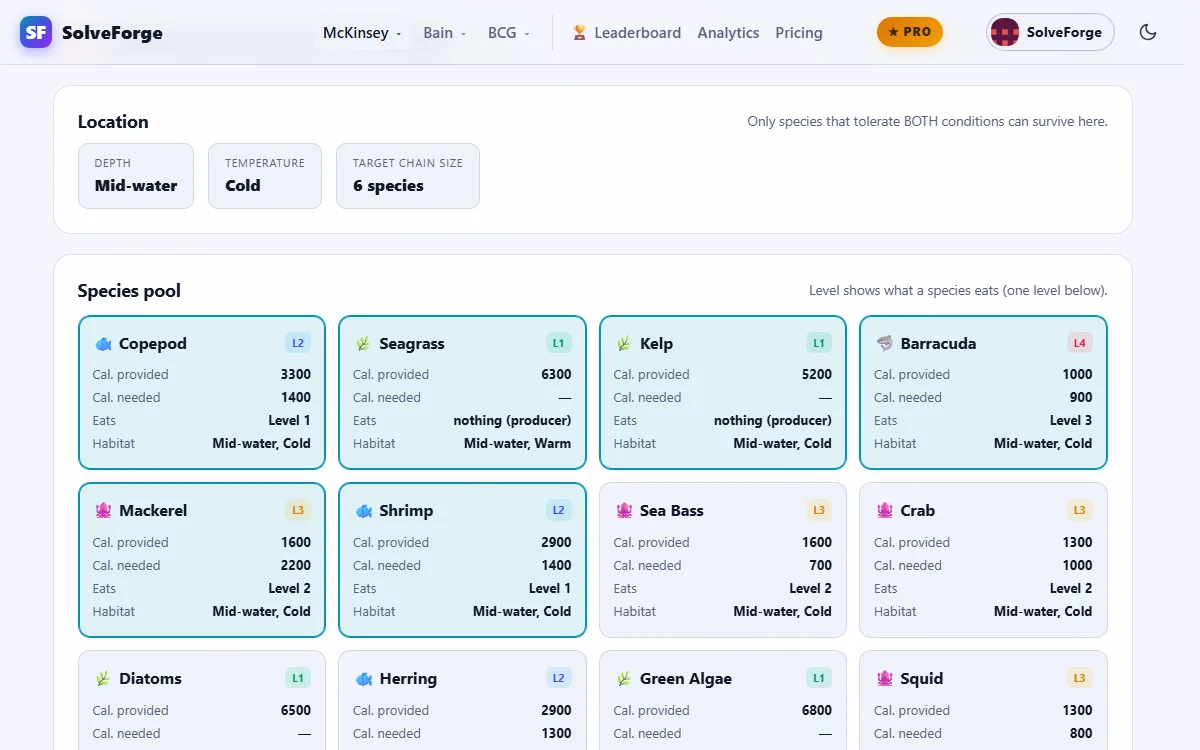
Location
Only species that tolerate BOTH conditions can survive here.Species pool
Level shows what a species eats (one level below).What the Ecosystem game was, and why it's still here
Ecosystem Building was part of the McKinsey Solve from the start, back when the test was still called the Problem Solving Game or the Imbellus game. Candidates chose species from a large pool to build a food chain that could survive in one location, then confirmed the location. McKinsey phased it out during 2025, and by 2026 almost nobody sees it. If your invitation says 65, 85 or 95 minutes, you won't. Don't prepare for it instead of Red Rock and Sea Wolf.
It's kept on SolveForge for one reason: it's a good reasoning drill. The rules interact, you have to trace consequences through a chain, and the clock is real. The habit of checking every rule before committing carries over to Sea Wolf.
What this simulator recreates
A species table with each species' habitat range, trophic level, calories provided and calories needed. You pick exactly six that survive together in the given location, on a 35-minute clock. A valid ecosystem passes three checks:
- Habitat: every species tolerates the location's depth and temperature.
- Food: every animal has prey one level below it in your chain. Producers eat nothing.
- Energy: after feeding resolves, every species still has calories provided above zero.
Feeding resolves in a fixed order: the animal with the highest calories provided eats first, taking its calories needed from the richest available prey one level down. There's a solver button that reveals one valid chain, so you can check your reasoning against a working answer instead of guessing.
What it doesn't do
It isn't the real test and doesn't use McKinsey's species or locations. The real version used a bigger pool and more species per chain; this is a compact version built from public descriptions of the rules. Since the game is retired, there's nothing current to match against, and this page won't pretend otherwise.
What's free
This game is Pro only. Red Rock and Sea Wolf each have a free scenario. Pro is $29 for 30 days or $69 for lifetime access, one payment either way, no subscription, and it opens this game and the Sustainable Futures Lab, and builds a new Red Rock study and new Sea Wolf sites on every run. This game builds a new habitat, species and calorie values every run. Details on the pricing page.
The current games are covered in the Red Rock guide, the Sea Wolf guide and the Sustainable Futures Lab guide.
SolveForge is an independent practice tool and is not affiliated with, endorsed by, or connected to McKinsey & Company. "McKinsey" and "Solve" are trademarks of their respective owners. Practising here does not guarantee any assessment result.