McKinsey Solve mock test
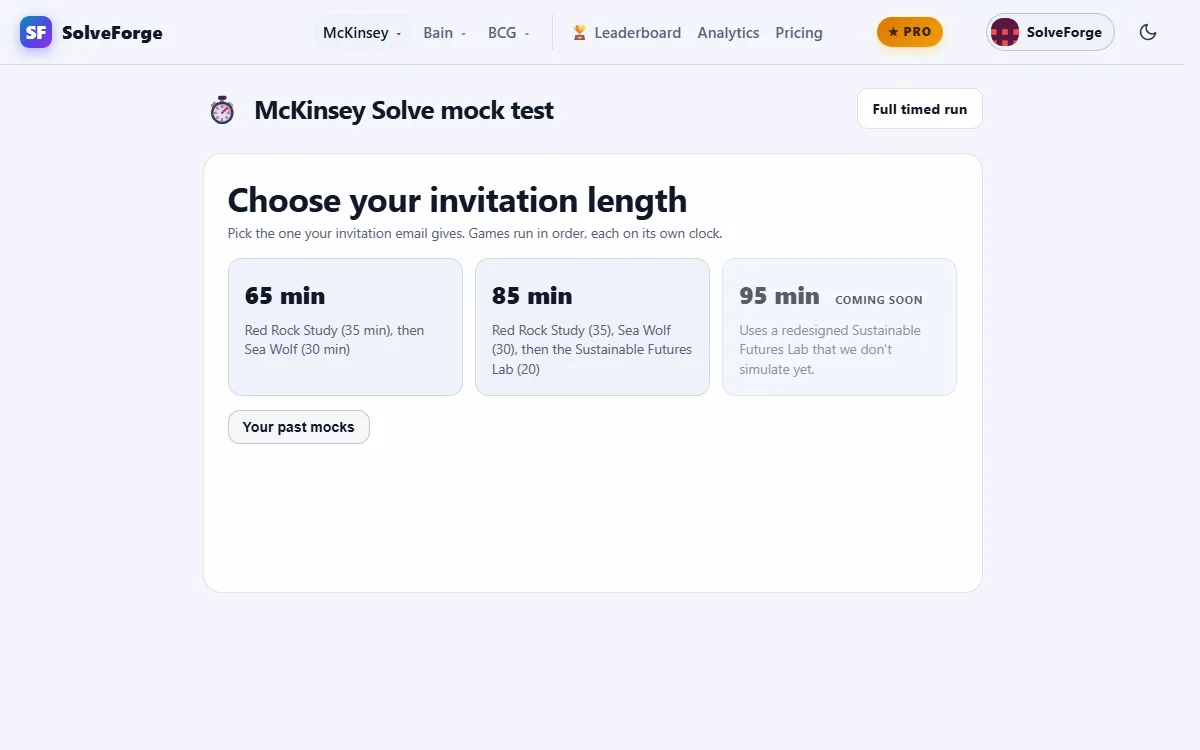
Choose your invitation length
Pick the one your invitation email gives. Games run in order, each on its own clock.
The mock needs a screen at least 860 pixels wide. Open it on a desktop or laptop: the real Solve runs only on a PC or Mac.
Mock
You'll play
- Use a desktop or laptop.
- Set aside the full time and do it in one sitting.
- Timers keep running if you leave or reload the page.
- No pausing, and no going back to a game you've finished.
- After each game, the next one starts when you click.
Your screen is narrower than 860 pixels, so the mock can't start here. Open it on a desktop or laptop.
You have a mock in progress
Create a free account first
The full timed mock is part of McKinsey Pro, and it needs an account so your results save. Free accounts can play one Red Rock and one Sea Wolf scenario. The written guides are open to everyone.
The full mock is part of McKinsey Pro
It plays a fresh scenario in every game, so the score reflects what you can do, not what you remember. Any pass that covers McKinsey includes it.
One-time payment. Not a subscription. Nothing auto-renews.
What this mock is
The McKinsey Solve is two or three games in a row, each on its own clock. Practising them one at a time is how you learn them. This mock is how you find out whether you can do them back to back: Red Rock, then Sea Wolf, then the Sustainable Futures Lab on the longer invitation, with no pausing inside a game and no going back to one you've finished.
Every game gets a fresh scenario, the same as any Pro run. At the end you get one report: a score for each game, the time you used against the time you had, and your weakest game with a link to its guide. Each game also saves as a normal run, so it still counts on the leaderboards.
Which invitations it covers
Your invitation email tells you how long your Solve is. Candidates and prep sites report three lengths in 2026, and the mock covers two of them.
- 65 minutes: Red Rock Study (35 minutes), then Sea Wolf (30 minutes).
- 85 minutes: the same two, then the original Sustainable Futures Lab (20 minutes).
- 95 minutes: not available yet. It's reported to use a redesigned 30-minute Sustainable Futures Lab, and we don't simulate that version yet.
Most reports put the games in that order, and a few describe a different one. McKinsey doesn't publish the line-up, so your invitation and the on-screen instructions are the final word. There's more on this in what 65, 85 and 95 minutes mean.
The rules it copies
- Each game has its own clock. Minutes you don't use in Red Rock don't carry over to Sea Wolf.
- You can't pause a game. If you leave the page or reload it, the clock keeps running, and you come back to the same scenario with whatever time is left.
- In the real test each game opens with an untimed tutorial, so here the next game starts when you click. Keep going in one sitting: a mock left for more than 30 minutes past its total time is marked abandoned.
- Red Rock gets 35 minutes here, matching recent reports. Our standalone Red Rock simulator runs 30.
How to use it
Take one mock early in your prep week to see where your time goes, and another a day or two before the real test. Use a desktop or laptop (the real Solve runs only on a PC or Mac) and sit somewhere quiet where you can finish in one go. Between the two, practise your weakest game on its own.
If you haven't played the games yet, start with the McKinsey Solve guide, then the Red Rock guide, the Sea Wolf guide and the Sustainable Futures Lab guide.
What it isn't
It's a recreation built from public information about the games, not the real test, and it doesn't use McKinsey's scenarios or scoring. McKinsey doesn't publish pass marks, so no score here predicts what McKinsey will see.
Who can take it
The mock comes with any pass that covers McKinsey: the McKinsey pass ($29 for 30 days), McKinsey + Bain ($45 for 30 days) or McKinsey lifetime ($69). There's no free version. Free accounts get one fixed scenario per game, and a mock on scenarios you've already seen would give you a score you can't trust. Details are on the pricing page.
FAQ
How long is the SolveForge mock test?
65 or 85 minutes of game time, matching the two McKinsey Solve invitation lengths that candidates report most. The 65-minute version is Red Rock then Sea Wolf. The 85-minute version adds the Sustainable Futures Lab.
Can I pause the mock?
No. Each game runs on its own clock, and leaving the page or reloading doesn't stop it. Between games, the next clock starts when you click, like the untimed tutorial before each game in the real test.
Why isn't there a 95-minute version?
Candidates report that the 95-minute invitation uses a redesigned, 30-minute Sustainable Futures Lab. Our simulator covers the original 20-minute format, so we won't offer a 95-minute mock until we can simulate the new one.
Does my mock score predict my McKinsey result?
No. The games are our recreations, built from public information, and McKinsey doesn't publish how it scores Solve or what counts as a pass.
Is the mock free?
No. It comes with any pass that covers McKinsey. Free accounts get one fixed scenario per game, and a mock on scenarios you've already played would overstate your score.
Do mock games count on the leaderboard?
Yes. Each game you finish in a mock saves as a normal run, so it counts toward that game's leaderboard and your SolveScore. There's no separate mock leaderboard.
SolveForge is an independent practice tool and is not affiliated with, endorsed by, or connected to McKinsey & Company. "McKinsey" and "Solve" are trademarks of their respective owners. Practising here does not guarantee any assessment result.