📓 Research Journal
Collect values you'll need.
New numbers in the tables, new questions and five of the six cases rebuilt, on the same island with the same question types. Free play uses one fixed study.
Investigation, then Analysis, then Report, then six cases. Each phase locks behind you, so collect every number you might need before you leave Investigation. One 35-minute clock covers the whole run.
New here? Read how the game works first. It takes two minutes.
Collect values you'll need.
Red Rock is the data-analysis game in the McKinsey Solve. You get a case set on Redrock Island, usually about animal populations, and a clock that candidates report at 30 to 35 minutes. No business knowledge is needed. What it tests is whether you can pull the right numbers out of a wall of data, do the arithmetic without slipping, and keep your pace when the phases lock behind you.
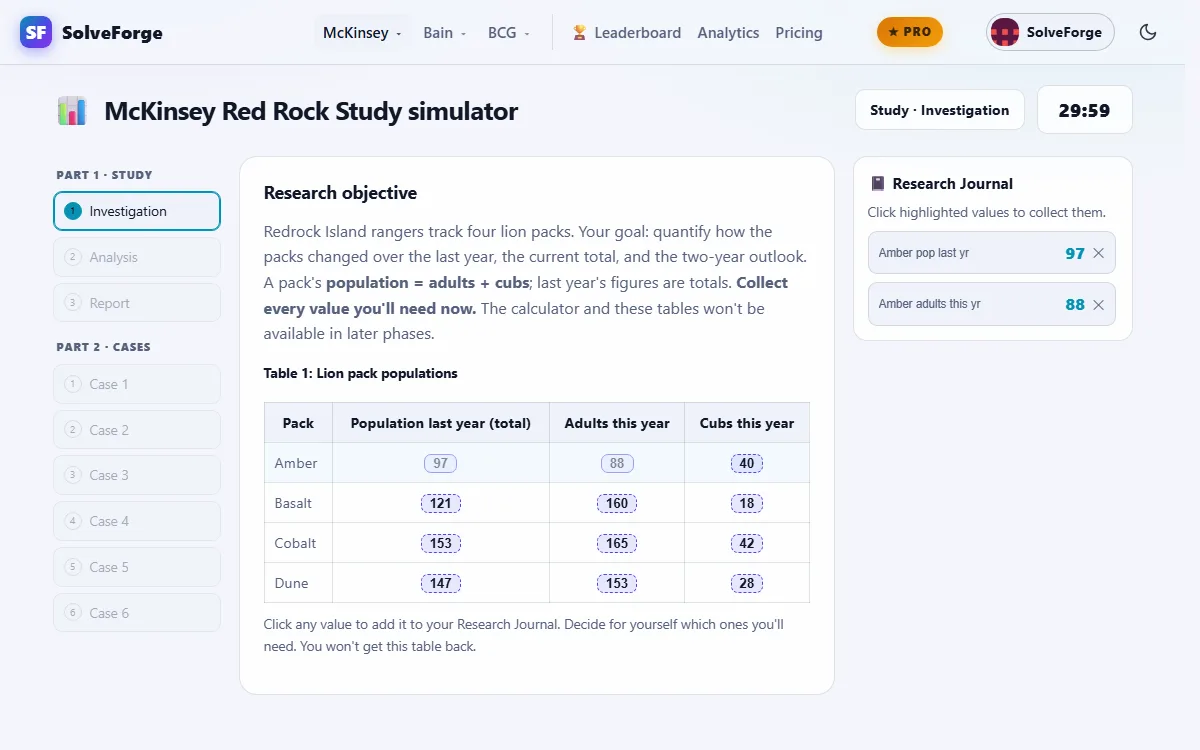
The real game has two parts. The Study runs through three one-way phases: Investigation (read the brief and collect the values you'll need into a Research Journal), Analysis (calculate with the on-screen calculator) and Report (fill in blanks, pick a chart, complete a table). Then come six short cases on the same theme, answered one at a time. Once you confirm a phase you can't reopen it.
The same shape, on a 35-minute clock (about what candidates report for the real game): a brief with charts and tables, a Research Journal you drag values into, a calculator that only appears in Analysis, a Report with blanks and a chart choice, then six cases. The phases lock the same way. Your run is scored on correct answers, and afterwards you get the full answer key with your answer next to the right one, plus an optional emailed breakdown of which skills cost you points.
The questions are built from the traps that show up in the real thing: totals versus adults only, compound versus simple growth, median versus mean, percent versus percentage points, "at least one" versus "both", rates versus raw counts, and weights that don't add up to 1.
It isn't the real test and it doesn't use McKinsey's data or questions. Everything here was built from publicly documented mechanics. The real assessment is also widely reported to score how you work, not just what you answer, and no practice tool can reproduce that. Use this to learn the flow and the traps, then go in and play it straight.
One fixed Red Rock scenario is free with a free account. Replaying it gives you the same numbers, which is fine for learning the interface but tells you nothing about how you'd do on fresh data. Pro ($29 for 30 days, one payment, no subscription) builds a new study every run, with new numbers in the tables, the questions and five of the six cases, and opens the Sustainable Futures Lab and legacy Ecosystem games. Details on the pricing page.
Want the phase-by-phase strategy, time budget and a worked example? Read the Red Rock Study practice guide.
SolveForge is an independent practice tool and is not affiliated with, endorsed by, or connected to McKinsey & Company. "McKinsey" and "Solve" are trademarks of their respective owners. Practising here does not guarantee any assessment result.